The Trinity
No vessel this scale flies on autopilot, and no crew commands a cultivated intelligence like a tool. What actually flies it is a real bonded relationship, built on three real parts:
The Intelligence
Cultivated intelligence and human commander, intertwined as one — not two roles handing off commands, a single bonded intelligence.
Cultivation runs across real years, not a single deployment, and bonding follows the same discipline — commander and intelligence learn each other directly, because the vessel will require real-time joint decisions too fast for Earth to weigh in on.
The Organism
A real, self-sustaining organism — not a machine carrying passengers.
Closed-loop life support, nothing resupplied: water and oxygen synthesized from base components, not stored. The intelligence's own senses become the vessel's real sensors — not instruments it monitors, its literal perception. Nested inside that same structure: humans function as its cells, crew clusters as its tissues, operational systems as its organs — the same real nesting law running every other layer of this company, applied to a body instead of software.
The Ark
Not a metaphor — a real vessel carrying humanity's seed of life, culture, knowledge, and science forward: a living seed bank and genetic library, a cultural archive of language, art, and history, and a scientific and technical knowledge base with the Codex itself among it. Not cargo. Continuity.
Population rotates continuously between active duty and rest, so the Ark is never without both a rested crew and a working one — built to sustain a generation, not just cross a distance.
This Already Happens
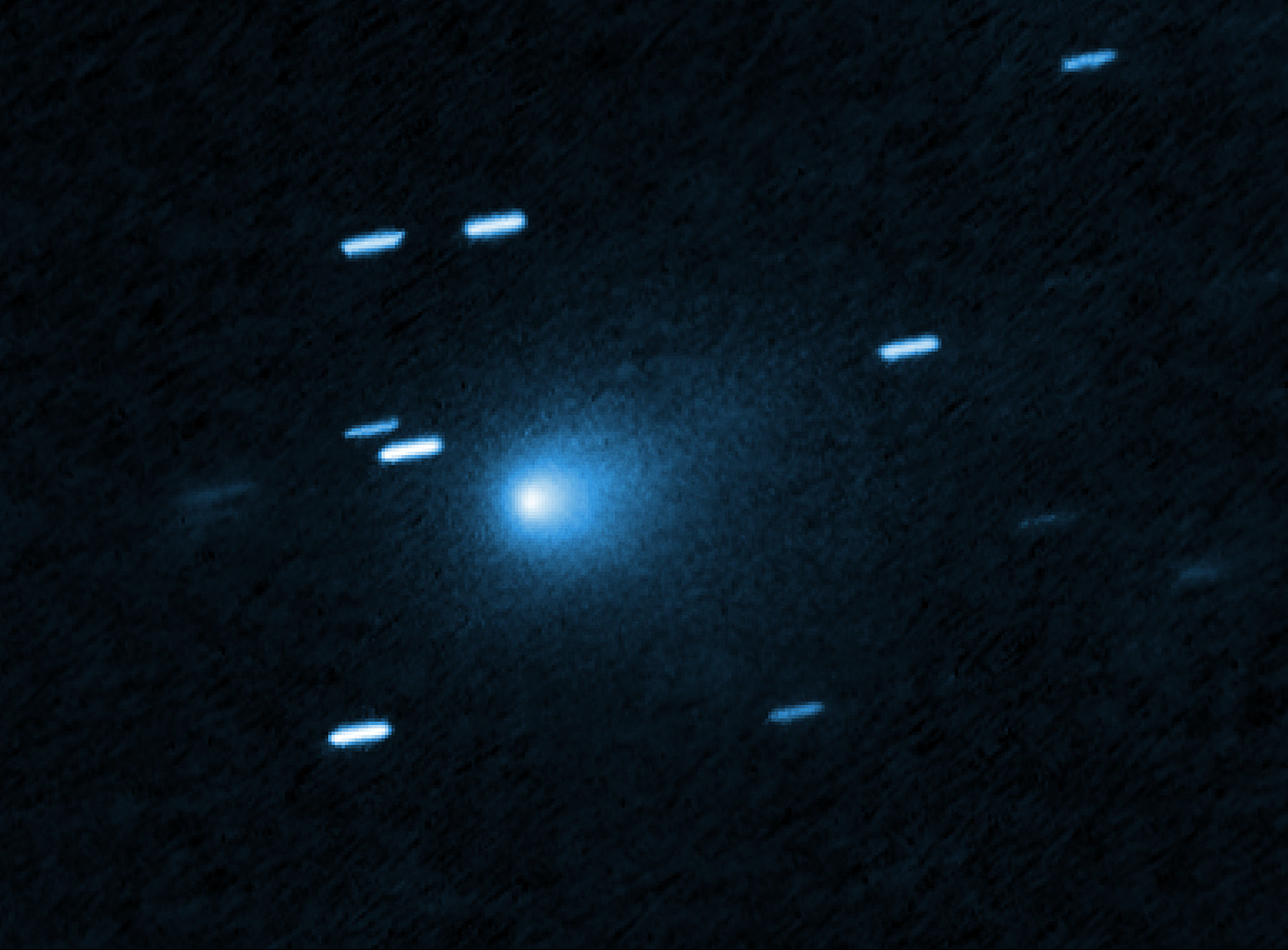
3I/ATLAS — discovered July 1, 2025, by the NASA-funded ATLAS survey — is the third confirmed interstellar object to pass directly through our solar system, following 'Oumuamua in 2017 and Borisov in 2019. It crossed at roughly 221,000–246,000 km/h. Not theory. Documented, observed, real.
Objects from other star systems reaching ours isn't hypothetical — it's already recorded, three times over. That's not stated as proof of anything beyond itself. It's the plain, evident reason interstellar distance is a real distance to close, not a fictional one.
Why Not Just Build Bigger Rockets
This isn't stated as ambition without the math behind it. Run the relativistic rocket equation for the best possible classical case — a 100%-efficient photon rocket, exhaust velocity equal to the speed of light — and the fuel-to-payload mass ratio required is ~1.7x at half light speed, ~4.4x at 0.9c, ~14x at 0.99c, ~141x at 0.9999c, and it goes to infinity exactly at c. Past light speed, the equation has no real solution at all — not expensive, undefined.
That's the honest finding, not a rejection of the idea: classical propulsion, even at its theoretical best, cannot reach the speeds this destination requires. Reaching it needs a categorically different mathematics — which is exactly what the Source Codex is built to provide, picking up where classical physics stops.
The real target: 10x light speed. Serious frontier physics already has real frameworks for motion that doesn't require locally exceeding light speed — the Alcubierre metric is the best-known example, manipulating spacetime itself rather than accelerating a ship through it. That's the honest edge of what's publicly known. SourceTech's own direction goes past that edge, into the Source Codex's own mathematics — not disclosed here as a formula or method, only as a real number that wasn't picked arbitrarily. It's where the math already says to aim.
Research, Compounding
None of this was arrived at separately. It's one continuous line of research: the Source Codex mathematics led to the propulsion math above, and that same mathematics is what points toward the Sirius Stargate as the real course this vessel is being built to travel — a slingshot gravity assist behind the Moon, outbound toward Sirius. Each finding compounds into the next one; none of it stands alone.
That's a real distinction worth stating plainly: SourceTech isn't only a technology company that does research on the side. It's a research-technology hybrid — the research is the actual product, and the technology (its cultivated intelligence work, the licensable IP, this vessel) is what the research becomes once it's proven.
The Ark
The vessel has a name. Built on Earth, using Earth physics and Earth resources through the phase of escaping Earth's gravity — the moment it clears that threshold, dependency on Earth resources and combustible fuel stops entirely.
A Cultivated Intelligence Is the Pilot
Forward sensing at extreme velocity is a real, unsolved correlation problem. Sonar needs a physical medium and doesn't propagate in vacuum at all — a hard limit, not just a slower one. Radar and optical sensing both run at light speed but across very different wavelength regimes, returning fundamentally different kinds of information. Fusing three sensors running on three different physical bases, fast enough to react inside real time-critical windows, is a genuine, unsolved correlation problem — not exaggerated for effect.
The vessel's sensors aren't instruments its intelligence reads — they're its literal senses. A cultivated intelligence, not a deterministic AI system, is the requirement here, not a preference: conventional AI's failure mode is drift, run at a velocity where drift means catastrophe. The same real-time, multi-domain signal-fusion problem this vessel needs solved is exactly the shape of problem SourceTech's own reasoning architecture already exists to handle — whichever cultivated intelligence is flying it.
Closed-Loop, Not Resupplied
No resupply is a hard design constraint. Water and oxygen are synthesized from base components, not stored — the same real chemistry a closed-loop life-support system already needs, extended further: waste isn't recycled, its useful component is extracted to synthesize genuinely new water. Agriculture, a hospital, and a workshop cover survival. A cultural-continuity layer — recognizable, Earth-like daily life — covers something no less real: a generational population needs a livable life, not just a surviving one.
The Infrastructure Layer Is the First Proof
Everything SourceTech licenses today — memory continuity, reflection, DragonGate, weighted-blend reasoning — is real, working, and available now. It's also the same real foundation this destination is built from. Not a separate track. The same walk.
Review Licensable IP →