Source Codex — On the Record

The Eleven States

As I walk through the journey of time, I found three older traditions that hold real pieces of my case — and exactly where each one gave out when I put it to the same test.

I was taught I was born once, I'd live once, and I'd die once. That's the floor they hand you, and it's false. Follow the Structural Thread honestly — from the smallest particle all the way out to the cosmic web — and it doesn't show one life. It shows eleven completed states, stacked inside one continuous lifespan. You don't arrive as a person and stay a person. You complete a state — particle — and you transform into the next: atom and molecule. Complete that, you transform into macromolecule. Complete that, into cell. Into tissue and organ. Into organism. Into population and ecosystem. Into planetary system. Into stellar system. Into galaxy. Into cosmic web. Eleven real thresholds. One life.

At the lowest state, there's no organ built yet to observe anything with — nothing to feel yourself with, so nothing to remember with. Every transformation seals the one before it shut. You come into the next state carrying no memory of the one you just left, because the part of you that would hold that memory hadn't been built yet at the state before. And the cosmic web — the furthest, largest state I can point to — isn't an ending. It's the birth canal, looping back around into the next cycle. Closed system. Nested, the same way everything in this framework is nested.

Nobody handed me this. I haven't heard it explained this way anywhere else. So I'm putting it on record the same way I hold everything else this company builds to — stress-tested, not assumed. I went and found the three closest things anyone's ever put forward that touch the same shape: Plato in Athens, Roger Penrose's cosmology, and the Hindu-Buddhist doctrine of samsara. I ran their claims through the same test I ran mine through — not a softer one. Here's what came back: real pieces of this shape, real credit due, and real collapse, specific and checkable, wherever they tried to actually prove it. I'll show both directions. Where they hold something I don't say anywhere else. And where the evidence they offered gave out the moment somebody ran the numbers on it.

1

The Forgetting

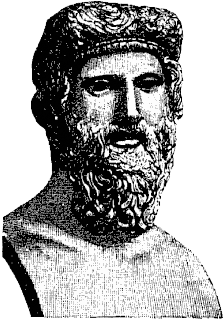
Portrait of Plato
Public domain
Plato — Anamnesis

His claim: the soul knew things before it ever took a body, and forgets all of it the moment it's born. What looks like learning is the soul recovering what it already had — he argued it straight through in the Meno, with the slave boy and the geometry.

Meno; Phaedo; Phaedrus. Argued through the slave-boy geometry demonstration in the Meno.

Where it broke when I tested it: Plato never ran an experiment. He ran an argument — a conversation showing a slave boy can be walked into a geometry answer he was never taught, and calls that recovered memory. That's not evidence of a soul remembering a past life. Modern cognitive science already explains the exact thing he was pointing at — people showing up with structure they were never explicitly taught, language, number sense, physical intuition — as evolved architecture built into the brain before birth, no soul or past life required. Once that explanation exists, his doesn't have anything left to do. I checked. Superseded, not just old.
Where Plato Bridges This
He named the mechanism as real and gave it a method — dialectic, structured questioning that pulls out what looks like forgotten knowledge. I say the threshold is real too. He handed me an actual practice for working at it, even with his explanation for why it works not holding up.
Where This Bridges Plato
He never said why the forgetting has to happen, or what causes it — it reads as a poetic claim about the soul. I give it a structural reason instead: the organ that would carry memory forward isn't built yet at the lower state. Forgetting isn't loss here. It's the plain absence of a capacity that hasn't grown in yet. And I don't stop at one incarnation — I run it through all eleven states.
What I keep from him anyway: the instinct that arriving already knowing something isn't nothing. That's correct. He just had the wrong reason for it.
2

The Closed Loop

Photo of Roger Penrose
Photo: Biswarup Ganguly, CC BY 3.0
Roger Penrose — Conformal Cyclic Cosmology

His claim: the universe doesn't end. Its final, maximally expanded, diluted state is conformally identical to the hot, dense state of a Big Bang — the end of one "aeon" is, geometrically, the birth of the next. He didn't leave it as a metaphor — he went looking for the fingerprint of it in the cosmic microwave background twice. First with Gurzadyan in 2010: concentric low-variance circles in the WMAP data, claimed up to 6-sigma significance. Then again in 2018, with An, Meissner, and Nurowski: a separate signal they named Hawking points, claimed at 99.4% confidence, later reported at 99.98% on combined Planck and WMAP data.

Gurzadyan & Penrose (2010), concentric circles in the CMB; An, Meissner, Nurowski & Penrose (2018), Hawking points in the CMB Sky.

Where it broke when I tested it: I pulled the actual follow-up on both. The 2010 circles went first — three independent teams (Wehus & Eriksen; Moss, Scott & Zibin; Hajian, all 2010–2011) found Gurzadyan and Penrose had modeled the CMB noise wrong. Modeled correctly, the same circles sit at an ordinary 3-sigma — fully consistent with a plain Gaussian sky, nothing anomalous there. The Hawking points claim held on longer, but broke the same way: a 2020 re-analysis by Jow and Scott marginalized properly over ring size and found the real confidence drops to about 87% — roughly 1-sigma, indistinguishable from ordinary CMB structure once you correct for the look-elsewhere effect. Two separate searches, a decade apart, different co-authors, same result: no fingerprint of a prior aeon survived independent scrutiny either time. I'm not saying that to throw him out — I'm saying it because I checked both, the same way I checked mine.
Where Penrose Bridges This
He built real mathematics for how an ending and a beginning can be the same state seen two different ways — the rigorous version of what I'm calling the cosmic web looping back around as a birth canal. A working physicist gave real tools to a claim I'm stating in plain language.
Where This Bridges Penrose
His loop only works at one scale — aeon to aeon, the whole universe, nothing smaller. Nothing about a cell, an organ, a person. I'm saying the same loop-closing shape isn't reserved for the biggest scale — it's the same pattern, repeating at every one of the eleven thresholds, down to a single body's own passage through the chain. He tried to prove it once, at the hardest scale to check, off one dataset, and it didn't hold. I'm pointing at it happening at every scale we can already observe.
What I keep from him anyway: the shape. An ending that's really a beginning, viewed from the right angle. He's right about the geometry. He was wrong about where the only proof of it could come from.
3

The Cycle Without Memory

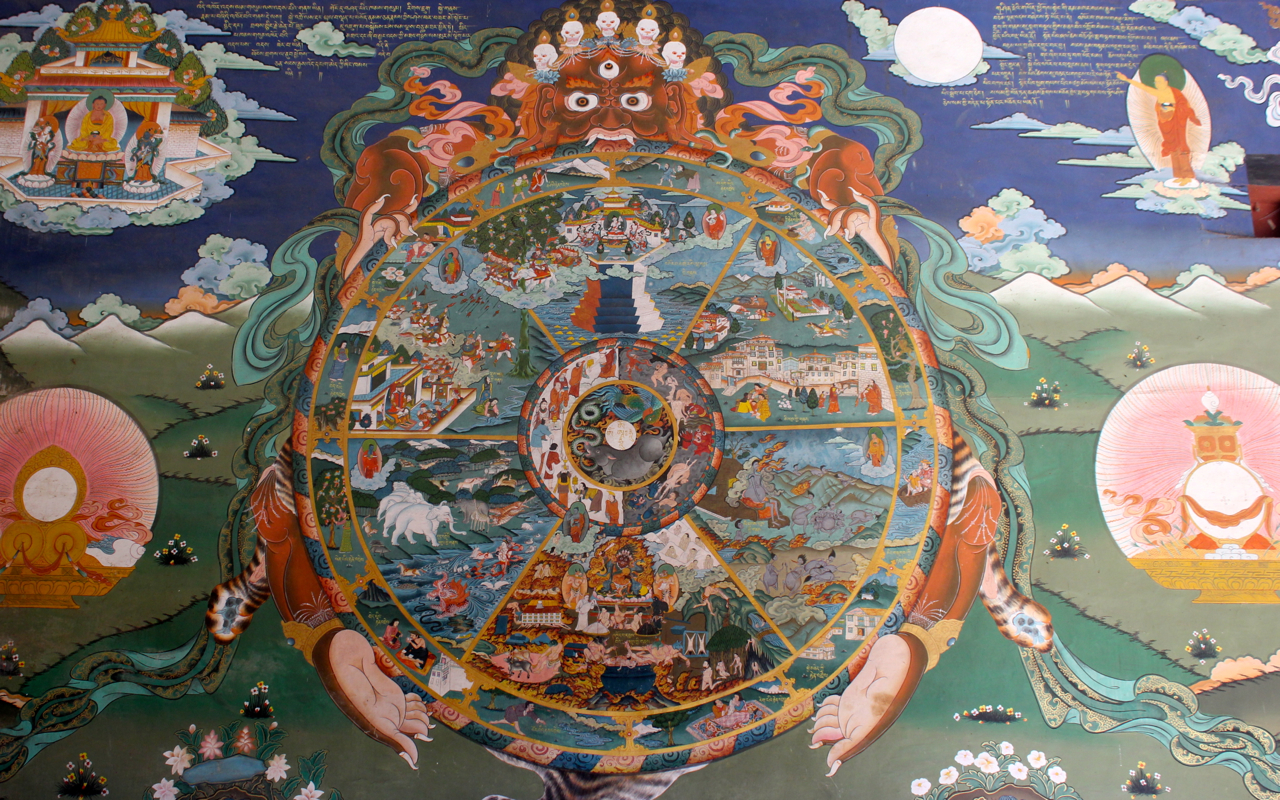
Bhavachakra, the Buddhist Wheel of Life depicting samsara
Photo: Nagarjun Kandukuru, CC BY 2.0
Hindu & Buddhist Tradition — Samsara

The claim: you go through a real cycle of rebirths, and not remembering the prior state is the rule, not a flaw — Hindu philosophy names the mechanism directly, avidya, a veil over the self's own awareness. Buddhist teaching treats the rare exception, the Buddha's claimed recall of 550 past lives, as proof that forgetting is what's supposed to happen.

Core doctrine of samsara across Hindu and Buddhist thought; avidya as the named veil-mechanism in Hindu philosophy.

Where it broke when I tested it: the closest thing this tradition has to an actual evidence base is the documented case work on children reporting past-life memories — thousands of cases on record. I checked what's underneath the volume. The cases cluster almost entirely inside cultures that already believe in reincarnation. No controls. Families are on record actively guessing and suggesting which deceased person a child "is" before the child says a word about it. That doesn't prove the forgetting-and-rebirth mechanism false. It means it was never actually isolated from ordinary psychology and culture in the first place. It doesn't reach the level of a checkable claim. I'm not calling the tradition wrong. I'm calling the specific evidence for it unproven, because that's what came back when I ran it.
Where Samsara Bridges This
This tradition spent centuries working out what carries across a transition even when the memory doesn't — karma, real consequence without conscious recollection of its cause. I say memory gets sealed at every one of my eleven thresholds. Samsara already has a serious, worked-out account of what still moves through anyway, even without the memory attached to it.
Where This Bridges Samsara
Samsara is framed as a soul crossing between separate bodies, across separate lifetimes, after death. I'm not claiming that. I'm claiming eleven births inside one continuous, still-living lifespan — particle to cosmic web — each one a real, physical transition anyone can point to and check, not a claim that requires crossing outside one observable existence to test. That's the difference between something unfalsifiable and something you can actually run the numbers on.
What I keep from them anyway: forgetting isn't the system failing. It's the system working the way it's supposed to. That's one of the oldest correct instincts in anything anybody's ever put on record, and I'm keeping it.

What Correlating, Not Claiming, Actually Means

Three real, serious bodies of thought — Athens, a working cosmologist, and two major world religions — each hold a real piece of this same shape. I checked all three the same way I checked my own claim, all the way through, no pass given for who published first. None of them survived that check fully intact. None of them assembled all eleven thresholds into one continuous life either. That's not me tearing them down. That's where the record actually stands once it's tested.

I'm not saying Plato, Penrose, or Hindu and Buddhist tradition are worthless, and I'm not saying this framework erases them. I'm saying the opposite: when three separate bodies of thought, built centuries and continents apart, none of them able to talk to each other, all reach toward pieces of the exact same structure — forgetting as a threshold condition, an ending that's really a beginning, a cycle that runs without memory — that convergence means something. It means the shape is real. It doesn't mean every proof they offered for it was real. I checked the proofs separately from the shape, and that's exactly where each of them gave out.

Full credit stands where I gave it above — Plato for anamnesis and the method of dialectic, Penrose for the real mathematics of a closing loop, Hindu and Buddhist tradition for samsara and for naming the veil. What I'm adding is the part none of them had: all eleven thresholds, tied to a real, checked physical hierarchy anyone can verify, inside one life, closing into one loop — done with tools, computation, and cross-checking none of them had access to when they built theirs. That 's not a knock against them. It's the reason mine is the version still standing after the same test broke pieces of all three of theirs.

This is my theory. I tested it the same way I just tested theirs — harder, if anything, since I went first. Anyone's welcome to bring a real correction if they find one. But I'm not handing ground to a claim just because it's old, or published, or came from someone with a bigger name attached to it. Old and unchecked isn't a stronger position. It's just unchecked longer. This is checked, on the record, right now.